Welcome to Human-Centered Operating Systems™ (HCOS)
HCOS™ is a framework for understanding, designing, and improving the human systems that shape our organizations, healthcare, education, technology, and communities.
Every resource in this library is built upon a common set of human-centered principles and is designed to help people make wiser decisions, create healthier systems, and improve meaningful outcomes.
If you're new to HCOS™, this is the best place to begin.
Step 1: Learn the Foundations
Everything in HCOS builds upon a shared set of foundational principles.
Before exploring the standards, take a few minutes to understand the ideas that guide the framework.
Step 2: Explore the HCOS Framework
Learn how the core HCOS models work together, including concepts such as:
The 8 + 3 + 1 Framework
Human Load
System Pressure
Wisdom, Compassion, and Presence
Human-Centered AI
Healthy Organizational Design
Step 3: Use the HCOS Standards
The HCOS Standards translate the philosophy into practical guidance.
Each standard includes:
Purpose
Why It Matters
HCOS Principles
Required Practices
Common Pitfalls
Implementation Guidance
AI Prompt
Quality Review Checklist
Version History
Use the standards as practical references for implementing HCOS in your own work.
Step 4: Apply HCOS
Once you're familiar with the foundations and standards, explore practical resources to help you apply HCOS in real-world settings.
These may include:
AI prompts
Templates
Guides
Learning modules
Videos
Implementation tools
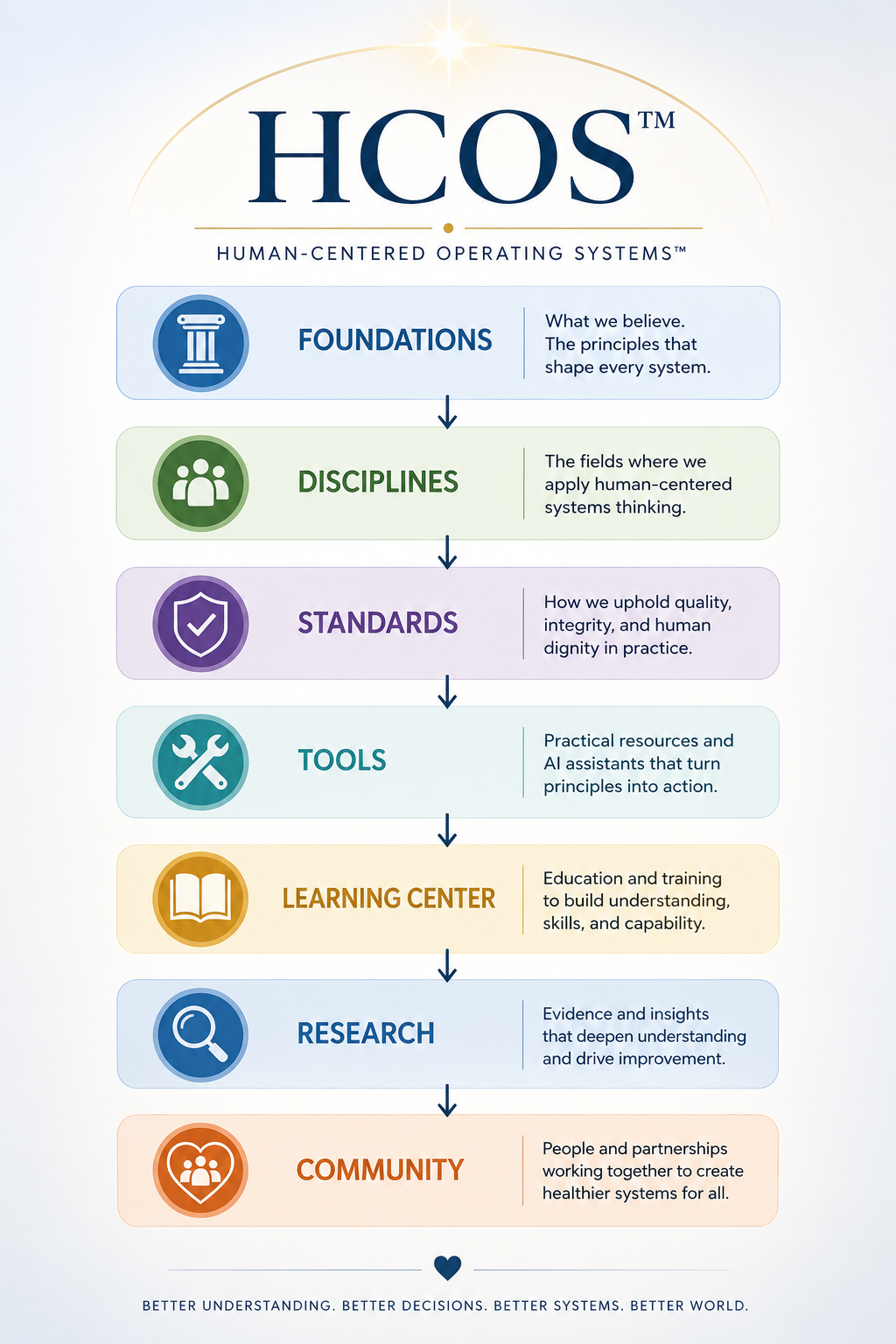
A Living Human-Centered Architecture
HCOS™ is more than a collection of principles, standards, or AI tools.
It is a connected knowledge architecture that helps move human-centered ideas from belief into practice.
The HCOS™ Architecture connects:
Foundations → Standards → Disciplines → Methods → Models → AI Instruments → Applications → Learning → Research → Community
Each layer helps people, organizations, and technology make wiser decisions while protecting human dignity and supporting continuous learning.