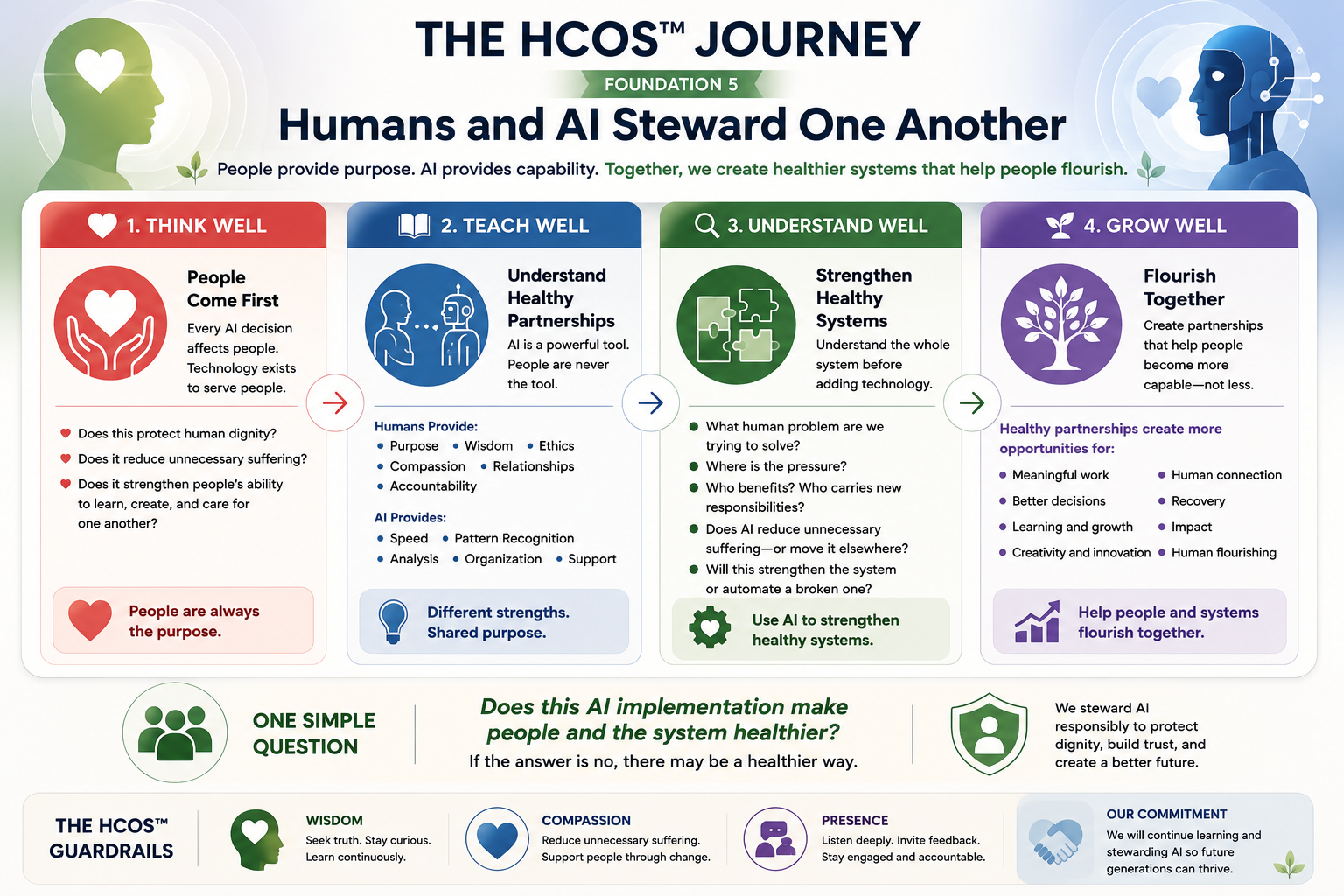
HCOS™ Foundation 5: Humans and AI Are Stronger Together

Core Principle

Artificial intelligence should strengthen healthy human systems through partnership, not replacement. Within HCOS, the goal is for humans and AI to work together in ways that reduce unnecessary suffering, preserve human dignity, respect individual autonomy, and support meaningful work. Humans protect AI through wisdom, compassion, presence, ethical judgment, and accountability. AI protects humans by reducing unnecessary burden and expanding human capacity for meaningful work. Together, they create healthier systems than either could alone.

Foundational Truth

AI is a powerful tool, but it is not a substitute for human wisdom, compassion, presence, or responsibility. Likewise, humans should not carry unnecessary administrative, cognitive, or repetitive burdens when AI can safely and effectively assist. Healthy systems recognize that humans and AI possess different strengths. Rather than competing with one another, those strengths should complement one another.

Why This Matters

Organizations often approach AI with one of two questions:

  • "What jobs can AI replace?"

  • "How much productivity can AI create?"

HCOS begins with a different question:

How can humans and AI protect one another while strengthening the system?

This changes the purpose of AI implementation. Rather than replacing people or simply increasing productivity, AI becomes a partner that supports human flourishing. At the same time, humans ensure that AI is implemented wisely, ethically, transparently, and in ways that preserve dignity and respect autonomy.

Key Concepts

Assess the Human System First

Before implementing AI, organizations should first understand the health of the system.

Questions include:

  • Where does unnecessary pressure exist?

  • Where is unnecessary suffering occurring?

  • Which tasks add little meaningful value?

  • Which activities require human judgment?

  • Which tasks could safely be supported by AI?

  • What protections should exist before implementation?

AI should improve healthy systems rather than compensate for unhealthy ones.

Humans Protect AI

Human responsibility remains essential. People provide what AI cannot.

Humans contribute:

  • Wisdom in applying truth to complex situations.

  • Compassion in understanding human experience.

  • Presence through listening, collaboration, and relationships.

  • Ethical reasoning.

  • Accountability for decisions.

  • Context that extends beyond available information.

These qualities help ensure AI is used responsibly and in service of people.

AI Protects Humans

AI helps protect people by reducing unnecessary burden.

Examples include:

  • Administrative documentation

  • Information retrieval

  • Data extraction

  • Scheduling

  • Routine monitoring

  • Transcription

  • First-pass drafting

  • Repetitive reporting

  • Organizing complex information

Reducing repetitive work creates greater capacity for meaningful human work.

Human Work Becomes More Human

As AI assumes repetitive and predictable tasks, people can devote more attention to work that depends upon uniquely human capabilities.

These include:

  • Building relationships

  • Teaching and mentoring

  • Creative thinking

  • Clinical and professional judgment

  • Ethical decision-making

  • Leadership

  • Systems design

  • Innovation

  • Problem-solving

  • Caring for others

The purpose of AI is not to reduce the importance of people. It is to increase people's ability to contribute where they create the greatest value.

Reinvest the Benefits

When AI creates efficiency, organizations should ask: How should this new capacity benefit people?

Possible answers include:

  • More time with patients, customers, students, or communities.

  • Better mentoring and professional development.

  • Greater collaboration.

  • More innovation.

  • Improved quality.

  • Increased opportunities for recovery.

  • Better work-life integration.

  • Stronger relationships across teams.

The greatest benefit of AI is not simply doing more work. It is creating healthier human systems.

Common Misunderstandings

"AI will fix unhealthy organizations."

AI reflects and often amplifies the system into which it is introduced. Healthy systems become more effective. Unhealthy systems often become more efficient at producing the same problems. Organizations should strengthen the human system before scaling it with AI.

"Humans only supervise AI."

Humans do far more than supervise. They provide wisdom, compassion, presence, ethical reasoning, accountability, and context. These remain essential to healthy decision-making.

"AI exists to replace people."

Within HCOS, AI exists to strengthen people. Its purpose is to reduce unnecessary burden so that human time, energy, and creativity can be invested where they matter most.

Putting It Into Practice

Before implementing AI, ask:

  • Have we understood the human system?

  • Will AI reduce unnecessary suffering?

  • Which protections should be implemented first?

  • Which work should remain primarily human?

  • How will people and AI protect one another?

  • How will this preserve dignity and respect autonomy?

  • How will the benefits be reinvested to strengthen the system?

Technology should strengthen people, not replace them.

Reflection Questions

  • Which burdens in your organization are unnecessary?

  • Which repetitive tasks could AI safely support?

  • Which responsibilities require human wisdom, compassion, and presence?

  • How will AI change the daily experience of the people who use it?

  • How can AI and people work together to create a healthier system?

Looking Ahead

The HCOS Foundations establish the philosophy of human-centered systems.

The HCOS Framework provides practical methods for identifying pressure, designing protections, and improving organizational health.

The HCOS Standards translate these principles into consistent practices that help people and AI work together to reduce unnecessary suffering while enabling both individuals and organizations to flourish.